- 1The Scale of Plastic Use in the NHS
- 2Plastic Production and Carbon Emissions
- 3The NHS Net Zero Commitment
- 4Where Bioplastics Could Make a Difference
- 5Reducing Carbon Emissions at the Source
- 6Not Every Plastic Can Be Replaced
- 7Beyond Material Replacement: Supporting the Circular Economy
- 8Innovation Will Drive the Next Phase of Sustainable Healthcare
- 9How EcoSprout Supports Sustainable Change
- 10Looking Ahead
The National Health Service (NHS) is one of the world’s largest healthcare systems, serving millions of patients every day. From life-saving surgical equipment to diagnostic testing and food packaging, plastics have become an essential part of modern healthcare. Their durability, sterility, and affordability make them difficult to replace in many clinical settings.
However, this dependence on conventional petroleum-based plastics comes at a significant environmental cost.
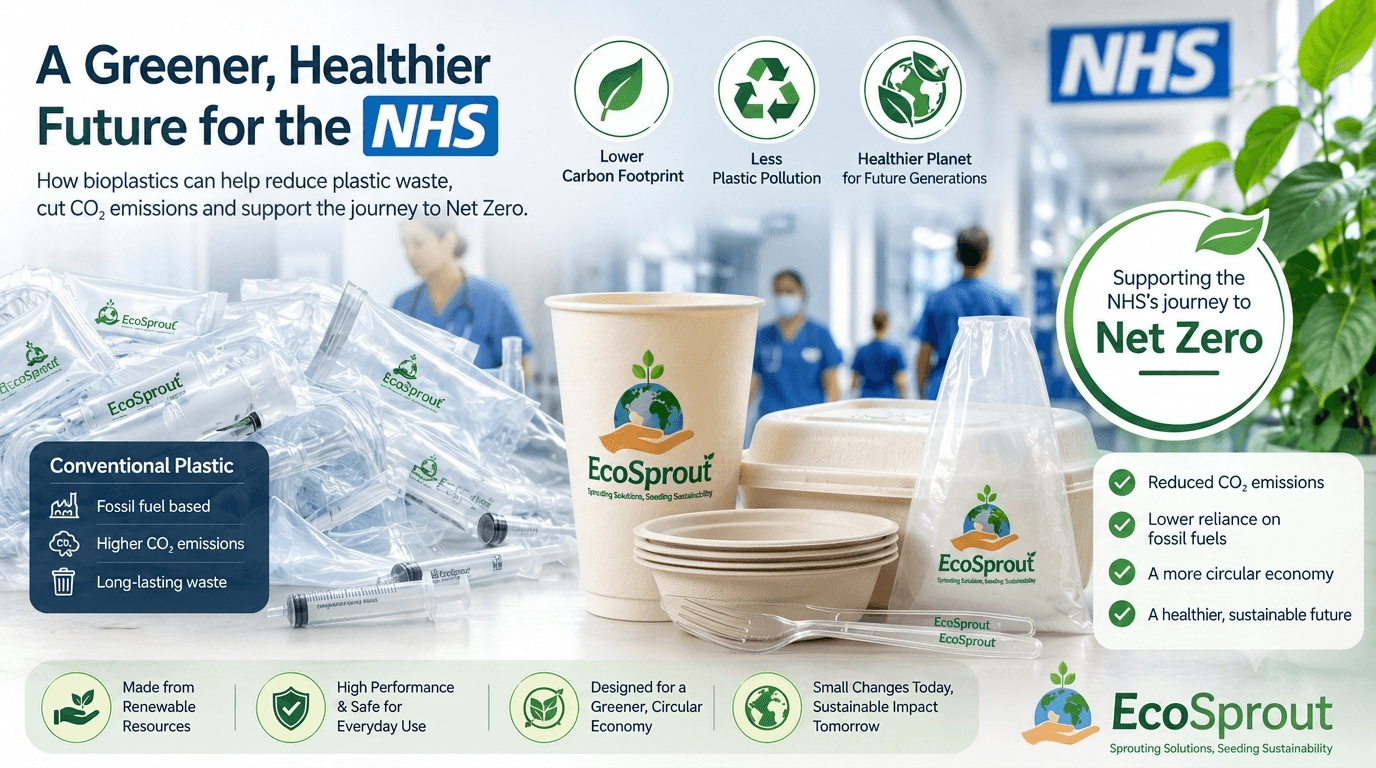
As the NHS continues its ambitious journey towards achieving Net Zero, reducing the carbon footprint associated with plastic products has become a key priority. While recycling, waste reduction, and circular economy initiatives are already making an impact, bioplastics are emerging as an important innovation that could further reduce greenhouse gas emissions without compromising patient safety.
The Scale of Plastic Use in the NHS
Every day, NHS hospitals and healthcare facilities use enormous quantities of single-use plastic items, including:
- Surgical trays
- Syringes
- IV bags and tubing
- Gloves
- Aprons
- Sample containers
- Packaging materials
- Catering products
Many of these products are designed for one-time use to maintain strict infection prevention standards.
According to NHS England, millions of disposable plastic items are consumed annually across healthcare settings. Between 2013 and 2018 alone, NHS services used more than 600 million disposable cups, alongside millions of other single-use plastic catering items, highlighting the sheer scale of plastic consumption within the healthcare system.
Although clinical plastics play an essential role in protecting patients, the production, transportation, and disposal of conventional plastics contribute significantly to carbon emissions.
Plastic Production and Carbon Emissions
Traditional plastics are manufactured primarily from fossil fuels such as crude oil and natural gas.
The production process involves:
- Extraction of raw materials
- Refining petroleum
- Manufacturing polymers
- Transporting finished products
- Disposal through incineration or landfill
Each stage generates greenhouse gas emissions.
When single-use plastics are incinerated after use—a common practice for clinical waste—they release additional carbon dioxide into the atmosphere. Because many medical plastics cannot currently be recycled safely due to contamination risks, incineration remains the primary disposal route.
This makes reducing the carbon intensity of plastic materials increasingly important.
The NHS Net Zero Commitment
In 2020, the NHS became the first national health system in the world to commit to achieving net zero carbon emissions. The strategy includes two major targets:
- Net Zero for emissions directly controlled by the NHS by 2040
- Net Zero for emissions influenced through suppliers and procurement by 2045
The NHS has already made substantial progress, reporting a 68% reduction in direct emissions compared with 1990 levels, and remains on track to meet its interim targets.
However, procurement remains one of the biggest challenges.
Approximately two-thirds of the NHS carbon footprint comes from the products and services it purchases—including medical equipment, pharmaceuticals, and plastic-based consumables.
This creates an enormous opportunity for suppliers to develop lower-carbon alternatives.
Where Bioplastics Could Make a Difference
Bioplastics are materials derived wholly or partly from renewable biological resources such as:
- Corn starch
- Sugarcane
- Cellulose
- Vegetable oils
- Agricultural waste
- Plant fibres
Some bioplastics are biodegradable or compostable under specific conditions, while others are designed to perform like conventional plastics but with a significantly lower carbon footprint.
Importantly, “bioplastic” does not automatically mean biodegradable. Different materials have different properties, making careful material selection essential for healthcare applications.
Reducing Carbon Emissions at the Source
One of the greatest advantages of many bio-based plastics is that their feedstocks absorb carbon dioxide while growing.
Unlike fossil-based plastics, which introduce new carbon into the atmosphere, bio-based materials can reduce lifecycle greenhouse gas emissions when responsibly sourced and manufactured.
The NHS’s own Net Zero strategy identifies bio-based polymers as an innovation with significant carbon-saving potential, estimating they could contribute savings of approximately 498,000 tonnes of CO₂e over time as suitable substitutions become available.
While this does not mean every plastic product can simply be replaced overnight, it demonstrates the important role that lower-carbon materials could play in future healthcare procurement.
Not Every Plastic Can Be Replaced
Healthcare has unique safety requirements.
Many medical products require:
- Long-term sterility
- Chemical resistance
- High strength
- Heat resistance
- Regulatory approval
- Biocompatibility
For these reasons, conventional medical-grade plastics will remain necessary in many critical applications for the foreseeable future.
However, numerous non-clinical and lower-risk products may offer opportunities for substitution, including:
- Catering products
- Packaging
- Disposable office supplies
- Visitor items
- Plant pots and landscaping materials
- Certain transport packaging
- Selected healthcare consumables where regulations permit
Replacing even a portion of these products with responsibly sourced bioplastics could contribute to meaningful carbon reductions.
Beyond Material Replacement: Supporting the Circular Economy
Bioplastics should not be viewed as a standalone solution.
Reducing environmental impact requires a broader approach that includes:
- Reducing unnecessary single-use products
- Designing products for reuse where safe
- Improving recycling systems
- Better waste segregation
- Sustainable procurement
- Material innovation
The NHS Clinical Waste Strategy highlights that improving waste management could reduce waste-related carbon emissions by around 30% while delivering significant financial savings.
Innovative recycling initiatives are already demonstrating what’s possible. For example, NHS-supported projects have shown that clinical plastics can be safely decontaminated and recycled into new laboratory products, with carbon emissions reduced by around 90% compared with incineration in pilot schemes.
Bioplastics can complement these efforts by providing additional lower-carbon material choices where appropriate.
Innovation Will Drive the Next Phase of Sustainable Healthcare
The transition to a lower-carbon healthcare system will require collaboration between:
- Healthcare providers
- Manufacturers
- Material scientists
- Procurement teams
- Sustainability specialists
- Policymakers
No single innovation will solve the challenge.
Instead, progress will come from combining better product design, responsible sourcing, smarter procurement, improved recycling, and the gradual adoption of sustainable materials such as bioplastics where they meet clinical, safety, and regulatory requirements.
How EcoSprout Supports Sustainable Change
At EcoSprout, we believe sustainable materials have an important role to play in reducing dependence on fossil-fuel-derived plastics.
As bioplastic technologies continue to evolve, businesses and public sector organisations—including healthcare providers—have increasing opportunities to reduce their environmental impact through smarter material choices.
Supporting the transition to lower-carbon alternatives today helps build a more resilient, circular economy for tomorrow.
Looking Ahead
The NHS has demonstrated global leadership by committing to one of the most ambitious decarbonisation programmes in healthcare.
Achieving Net Zero will require innovation across every aspect of the supply chain—including plastics.
While bioplastics are not a universal replacement for conventional plastics, they represent an exciting opportunity to reduce lifecycle carbon emissions, diversify sustainable material options, and support the wider transition towards a circular economy.
Together with recycling, waste reduction, improved procurement, and continued innovation, bioplastics can become an important part of the NHS’s pathway to a healthier planet—and healthier communities.