Every day, households, restaurants, cafés, offices and other businesses across London produce food waste. Vegetable peelings, fruit scraps, leftovers, tea bags and coffee grounds can quickly fill a kitchen food waste caddy.
Separating this waste from general rubbish is an important part of responsible waste management.
One simple way to make food waste collection cleaner and easier is to use a suitable certified compostable food waste liner where your local council permits or requires one.
Across London, councils have introduced food waste collection services and provide different guidance on how residents should line their caddies. For example, Lambeth Council says that food waste caddies must be lined with compostable material if residents choose to line them, while Croydon specifies 100% compostable liners meeting BS EN 13432:2000. The City of London provides residents with compostable liners for their food waste service.
At EcoSprout Ltd, we provide a wide range of compostable products for households, hospitality businesses, retailers and organisations looking for practical alternatives to conventional plastic.
What Is a Compostable Food Waste Bag?
A compostable food waste bag is a liner designed to break down under the appropriate composting or organic-waste treatment conditions.
These bags are commonly manufactured using materials such as starch-based bioplastics or other compostable materials and are designed specifically for applications such as food waste collection.
It is important to understand that “compostable” does not simply mean “biodegradable.”
When buying a liner for your food waste caddy, look for the appropriate certification and logo specified by your local authority.
For example, Lambeth and Croydon advise residents to use compostable liners certified to BS EN 13432:2000.
Why Do London Councils Encourage Food Waste Separation?
Food waste should not simply be treated as ordinary rubbish.
When food waste is collected separately, it can be sent to dedicated treatment facilities where it can be processed to recover useful resources.
The City of London, for example, explains that food waste can be treated through anaerobic digestion, producing biogas that can be used to generate energy as well as a nutrient-rich digestate that can be used as fertiliser.
London’s approach to food waste collection has also been expanding. The Mayor’s office has stated that boroughs are required to provide separate food waste collections in line with the rollout of national Simpler Recycling requirements.
This means separating food waste is becoming an increasingly important part of everyday waste management for London households and businesses.
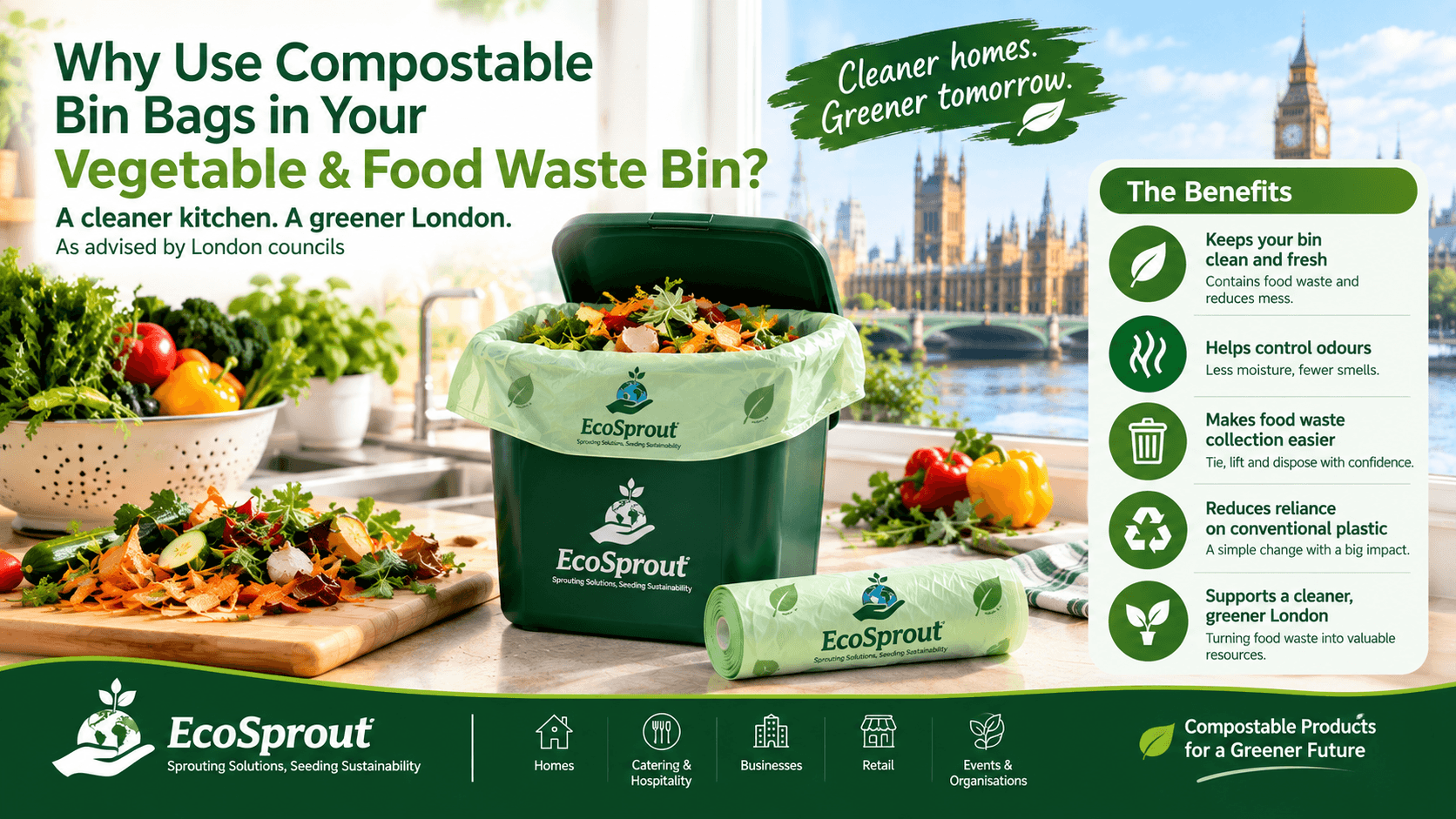
1. Compostable Bags Make Food Waste Easier to Handle
Let’s face it: handling loose food waste isn’t particularly pleasant.
Vegetable peelings can be wet, sticky and messy. Fruit scraps can create odours, while food residue can stick to the inside of a kitchen caddy.
A suitable compostable liner provides a simple barrier between the food waste and the inside of the caddy.
Once the bag is full, it can be tied and transferred according to your council’s collection instructions.
This makes the process of separating food waste considerably more convenient.
2. They Help Keep Your Kitchen Caddy Cleaner
One of the biggest advantages of using a food waste liner is cleanliness.
Without a liner, food residue can accumulate at the bottom and sides of the caddy. Moist vegetable peelings and other food scraps can make the container difficult to clean.
Lining the caddy can help minimise this problem.
Lambeth Council specifically notes that lining the food waste bin helps keep it clean and odour free, while Hounslow Council similarly recommends lining the caddy to make it easier to empty and keep clean.
For busy households and commercial kitchens, this small convenience can make food waste recycling much easier to maintain.
3. Compostable Liners Can Help Control Odours
Food waste can become unpleasant if it remains in a warm kitchen for too long.
Vegetable scraps, fruit peelings and leftover food contain moisture, and this can contribute to unpleasant smells.
Using an appropriate liner and emptying your caddy regularly can help keep the kitchen cleaner and fresher.
The City of London recommends emptying food waste caddies regularly to help avoid unwanted smells.
A useful tip is to avoid allowing liquid to accumulate in the bottom of your caddy. You can also use a small amount of kitchen roll or newspaper where permitted to absorb excess moisture.
4. They Can Make Food Waste Recycling More Convenient
One of the biggest barriers to recycling food waste is simply convenience.
If people have to handle loose food scraps every time they empty their kitchen caddy, they may be less inclined to use the food waste collection service.
A suitable liner makes it easier to:
- Collect vegetable peelings
- Dispose of food scraps
- Keep the caddy clean
- Reduce direct contact with food waste
- Tie up food waste before transferring it
- Empty the caddy quickly and hygienically
This is particularly valuable in busy households and commercial environments.
5. They Are a Better Alternative to Conventional Plastic Bags for Food Waste
A conventional plastic bag is not the same as a compostable food waste liner.
Plastic bags can contaminate food waste collections because they generally do not break down during the relevant treatment process.
Lambeth Council explicitly states that plastic bags should not be used because they do not break down during composting.
Similarly, Croydon Council advises residents to use 100% compostable liners and warns that bags marketed simply as “biodegradable” may not break down quickly enough during the recycling process.
The key message is simple: don’t assume that every “eco” or “biodegradable” bag is suitable for food waste collection.
Always check the certification and your local council’s requirements.
Compostable vs Biodegradable: What’s the Difference?
This is an important distinction for consumers.
The word biodegradable can describe a material that breaks down through biological activity, but it does not necessarily tell you how quickly it will break down or under what conditions.
Compostable products are designed to meet defined requirements for disintegration and biodegradation under specified composting conditions.
That is why councils such as Lambeth and Croydon specify certified compostable liners rather than simply accepting any bag marketed as biodegradable.
When choosing food waste bags, don’t just look for words such as:
- Eco-friendly
- Green
- Biodegradable
- Sustainable
Instead, check for the appropriate compostability certification and confirm that the product is accepted by your local waste collection service.
What Can You Put in a Vegetable or Food Waste Bin?
The exact rules depend on your council, but food waste collections commonly accept items such as:
- Fruit and vegetable peelings
- Fresh or cooked vegetables
- Fruit
- Leftover food
- Plate scrapings
- Meat and fish
- Bones
- Eggs and eggshells
- Dairy products
- Bread and pastries
- Tea bags
- Coffee grounds
For example, Barnet’s food waste guidance lists fruit and vegetables, including peelings, alongside many other types of food waste.
However, packaging should generally be kept out of the food waste caddy, even if the packaging claims to be compostable.
This is a particularly important point.
The fact that a product is technically compostable does not automatically mean it belongs in your council’s food waste collection.
Always follow your local council’s instructions.
What Should NOT Go in Your Food Waste Bin?
Items commonly excluded from food waste collections include:
- Conventional plastic bags
- Food packaging
- Plastic containers
- Cling film
- Foil
- Glass
- Metal
- Nappies
- Sanitary products
- Soil and rubble
- Garden waste, where separately collected
- Excess liquids, oil and fats
For example, Lambeth warns that packaging, including items labelled biodegradable, can contaminate the food waste stream.
The City of London also specifically asks residents not to put packaging or other compostable/biodegradable products such as cups and sponges into the food waste caddy.
So, a compostable food waste liner is not the same thing as putting compostable packaging into the food waste bin.
Do All London Councils Require Compostable Bin Bags?
No.
This is an important distinction.
London consists of numerous individual boroughs, and their food waste collection systems are not identical.
Some councils provide compostable liners. Some require residents to purchase approved liners. Some allow alternatives such as newspaper. Others have different requirements for food waste collection.
For example:
Lambeth Council says residents must use compostable material to line the food waste bin and specifies certified compostable liners.
Croydon Council recommends 100% compostable liners certified to BS EN 13432:2000.
Camden Council allows compostable liners, newspaper or kitchen roll for lining food waste caddies, while prohibiting plastic bin bags.
The City of London provides residents with compostable food waste liners as part of its food waste service.
Therefore, the best advice for London residents is:
Use the type of liner recommended or accepted by your local council.
Why Businesses Should Consider Compostable Food Waste Liners
The benefits aren’t limited to households.
Restaurants, cafés, hotels, offices, schools, care facilities, catering companies and other businesses can generate substantial quantities of food waste.
For commercial kitchens, keeping food waste contained can improve:
- Hygiene
- Cleanliness
- Waste handling
- Staff convenience
- Odour management
- Kitchen efficiency
ReLondon’s guidance on commercial food waste recycling notes that liner arrangements can vary between local authorities and that businesses should consider the requirements of the relevant waste collection and treatment system.
For this reason, businesses should choose food waste liners based not only on the product’s environmental claims but also on compatibility with their waste contractor and local collection requirements.
Why Choose EcoSprout Ltd for Compostable Products?
At EcoSprout Ltd, we understand that businesses and consumers are looking for practical ways to reduce their reliance on conventional plastic.
Our goal is to make sustainable alternatives more accessible by providing a wide selection of compostable products suitable for different everyday applications.
Our range includes compostable products for areas such as:
- Food waste collection
- Hospitality
- Catering
- Retail
- Events
- Food service
- Commercial premises
- Household use
Whether you need compostable bin bags for a kitchen caddy or other compostable products for your business, EcoSprout Ltd can help you find a suitable solution.
Making the Switch Is Simple
Becoming more environmentally responsible doesn’t always require a major lifestyle change.
Sometimes, it starts with something as simple as changing the bag you use in your food waste caddy.
Instead of reaching for a conventional plastic bag, check your council’s requirements and choose an appropriately certified compostable liner where permitted.
Then:
1. Line your food waste caddy.
2. Add your food and vegetable waste.
3. Keep packaging and non-food items out.
4. Tie the liner when full.
5. Transfer it to your designated food waste collection according to your council’s instructions.
6. Empty your caddy regularly.
It’s a small routine that can make food waste recycling cleaner and easier.
A Greener Choice Starts in the Kitchen
From the vegetable peelings left after preparing dinner to the food waste produced by a busy commercial kitchen, responsible waste management begins with separating the right materials.
Compostable food waste liners can make that process more convenient, cleaner and more hygienic.
But remember: not every compostable product belongs in a food waste bin, and not every council has exactly the same rules.
Always check your local London borough’s guidance before choosing or disposing of a liner.
At EcoSprout Ltd, we are proud to support households and businesses looking for practical compostable alternatives.
Looking for Compostable Products?
Whether you are a homeowner, restaurant, café, retailer, caterer or business, EcoSprout Ltd offers a wide range of compostable products designed to support more sustainable everyday practices.
Choose compostable. Reduce conventional plastic. Make a practical difference.
EcoSprout Ltd – Compostable Products for a Greener Future.
Frequently Asked Questions
Are compostable bin bags suitable for vegetable waste?
They can be, provided they are the correct type of certified compostable food waste liner and are accepted by your local council or waste collection provider.
Can I put a normal plastic bin bag in my food waste caddy?
Generally, no. Many London councils specifically prohibit conventional plastic bags in food waste collections because they can contaminate the waste stream. Always follow your local council’s instructions.
Are biodegradable bags the same as compostable bags?
No. “Biodegradable” is a broader term and does not necessarily mean that a bag is suitable for a particular food waste treatment process. Look for the certification required by your council.
What certification should I look for?
Some London councils, including Lambeth and Croydon, specify BS EN 13432:2000 for compostable food waste liners. Requirements can vary, so check your local authority’s current guidance.
Can compostable food packaging go into my food waste bin?
Not necessarily. A compostable food waste liner is different from compostable packaging. Some councils specifically instruct residents not to put compostable packaging into food waste collections.
Where can I buy compostable bin bags?
Compostable food waste liners are available from various retailers and specialist suppliers. EcoSprout Ltd provides a range of compostable products for household and commercial applications.
Should I use compostable bags if my council does not require them?
Check your council’s guidance first. Some councils permit or recommend compostable liners, while others provide different instructions or alternatives such as newspaper.
Final Takeaway
Compostable food waste liners can make separating vegetable and food waste easier, cleaner and more convenient.
However, the most sustainable choice is not simply to buy a bag labelled “eco-friendly”. Choose a properly certified liner that is compatible with your local council’s food waste collection system.
With food waste collections becoming increasingly important across London, simple changes in the kitchen can help make responsible waste disposal part of everyday life.
EcoSprout Ltd is here to make that change easier, with a comprehensive range of compostable products for homes, businesses and organisations.