As businesses and consumers look for practical ways to reduce their reliance on conventional single-use plastics, the materials we use for everyday food packaging and tableware are changing.
At EcoSprout, we believe sustainability should be practical, functional and accessible. One material that brings these qualities together is bagasse — a plant-based material that can be transformed into durable, attractive and compostable tableware.
What is Bagasse?
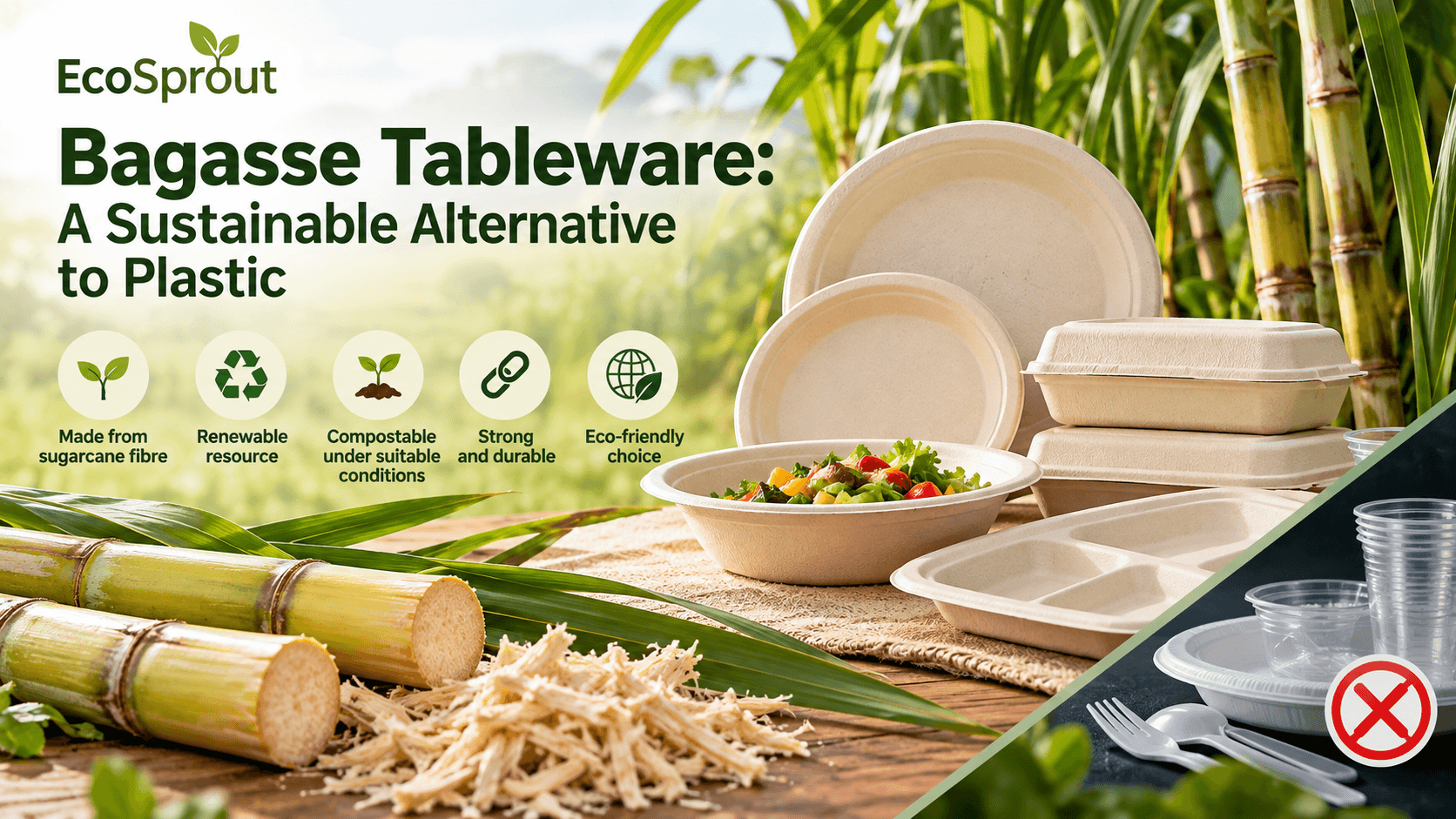
Bagasse is the fibrous material left behind after juice is extracted from sugarcane.
Rather than treating this agricultural by-product as waste, it can be processed and moulded into useful products such as plates, bowls, trays, takeaway containers and other foodservice tableware.
This gives an existing plant-based resource another useful life and reduces the need to manufacture certain disposable products from conventional fossil-fuel-based plastics.
Why Choose Bagasse Instead of Conventional Plastic?
Conventional plastic tableware is durable and convenient, but this durability becomes a disadvantage after disposal. Many conventional plastics can remain in the environment for long periods if they are not properly collected and recycled.
Bagasse offers a different approach.
Because it originates from sugarcane fibre, bagasse tableware is made primarily from a renewable plant-based resource rather than conventional petroleum-based plastic.
When appropriately certified bagasse products are disposed of through suitable composting systems, they can break down under the required composting conditions.
This makes bagasse particularly attractive for applications where disposable foodservice products are necessary but businesses want to reduce their reliance on conventional plastic.
Compostable by Design
One of the most important properties of bagasse tableware is its potential to be compostable.
Under appropriate composting conditions, certified compostable bagasse products can biodegrade rather than remaining as persistent conventional plastic waste.
However, it is important to understand that “compostable” does not mean a product should simply be discarded outdoors. Compostable products should always be disposed of according to their certification, local waste-management facilities and applicable collection requirements.
At EcoSprout, we believe clear disposal information is an important part of genuinely responsible packaging.
Strong Enough for Everyday Foodservice
Choosing more sustainable materials should not mean compromising on functionality.
Bagasse is naturally strong and can be moulded into rigid foodservice products capable of handling a wide range of foods.
Depending on the individual product specification, bagasse tableware can offer:
- Good strength and rigidity for everyday foodservice
- Resistance to oils and grease, making it suitable for many meals
- Suitability for hot and cold foods
- A clean, natural appearance
- A lightweight but practical construction
- A wide variety of shapes and sizes
This makes bagasse suitable for restaurants, cafés, catering businesses, takeaway services, offices, schools, events, parties and many other foodservice environments.
Turning an Agricultural By-Product into Something Useful
One of the most compelling aspects of bagasse is where it comes from.
Sugarcane is primarily grown for its juice and sugar. After extraction, large quantities of fibrous material remain.
Using this fibre to manufacture tableware provides a productive use for a material generated by another industry.
Instead of relying solely on newly produced fossil-based raw materials for disposable tableware, bagasse allows foodservice products to be created from renewable plant fibre derived from an agricultural by-product.
That is an excellent example of how thoughtful product design can make better use of existing resources.
Bagasse vs Conventional Plastic Tableware
| Bagasse Tableware | Conventional Plastic Tableware |
|---|---|
| Made primarily from sugarcane fibre | Commonly made from fossil-fuel-derived polymers |
| Uses an agricultural by-product | Requires plastic raw materials |
| Compostable when appropriately certified and processed | Generally not compostable |
| Suitable for many hot and cold foods | Suitable for hot/cold foods depending on plastic type |
| Natural, fibre-based appearance | Typically smooth plastic appearance |
| Can reduce reliance on conventional single-use plastic | Maintains reliance on conventional plastic |
Bagasse isn’t the solution to every environmental challenge, and reusable tableware remains preferable in many situations where washing and reuse are practical.
However, when single-use tableware is genuinely needed, bagasse can provide a compelling alternative to conventional disposable plastic products.
Ideal for Businesses Making More Sustainable Choices
For restaurants, caterers, cafés, hotels, events and foodservice distributors, switching materials can be one practical part of a wider sustainability strategy.
Bagasse products can be particularly useful for:
Takeaway meals — clamshells and containers for serving a variety of foods.
Catering and events — plates, bowls and trays without relying on conventional plastic tableware.
Restaurants and cafés — takeaway and delivery packaging that complements an environmentally conscious brand.
Corporate and institutional catering — practical tableware for workplaces, schools, universities and other organisations.
Foodservice distributors — a growing sustainable product category for customers seeking alternatives to conventional plastics.
Small Changes Can Have a Bigger Impact
Creating a more sustainable future doesn’t depend on one material or one product.
It comes from reconsidering how products are designed, sourced, used and ultimately disposed of.
Bagasse demonstrates what’s possible: taking the fibrous by-product of sugarcane processing and transforming it into useful foodservice products that can offer an alternative to conventional plastic tableware.
At EcoSprout, our goal is to help businesses and consumers make practical choices that reduce reliance on conventional single-use plastics while maintaining the quality and convenience they need.
Grow Greener with EcoSprout
From everyday meals and takeaway services to catering and large events, bagasse tableware offers a practical combination of functionality, renewable plant-based materials and compostability.
By choosing thoughtfully designed alternatives and disposing of them correctly, businesses can take meaningful steps toward reducing their dependence on conventional single-use plastics.
EcoSprout — practical products for a greener tomorrow.