Plastic has become an essential part of modern life. It is lightweight, versatile, durable, and used in everything from food packaging and retail products to healthcare and manufacturing. But the same durability that makes conventional plastic useful has also created one of the world’s most persistent environmental challenges.
As plastic waste continues to place pressure on our ecosystems and waste-management systems, the need to rethink the materials we use has never been more important.
This is where bioplastics and other sustainable material solutions have an increasingly important role to play.
At Ecosprout, we believe that building a more sustainable future starts with the choices we make today. By exploring responsible alternatives, reducing unnecessary waste, and thinking carefully about the entire life cycle of the products we use, we can take meaningful steps towards a greener tomorrow.
The Growing Need for Sustainable Materials
For decades, conventional plastics have been produced primarily from fossil-based raw materials. When plastic products are poorly managed at the end of their useful life, they can accumulate in the environment and contribute to pollution.
The challenge is complex. We cannot simply eliminate every plastic product overnight, nor is replacing one material with another automatically the best environmental solution.
Instead, we need to rethink the way we design, manufacture, use, and dispose of materials.
This means asking better questions:
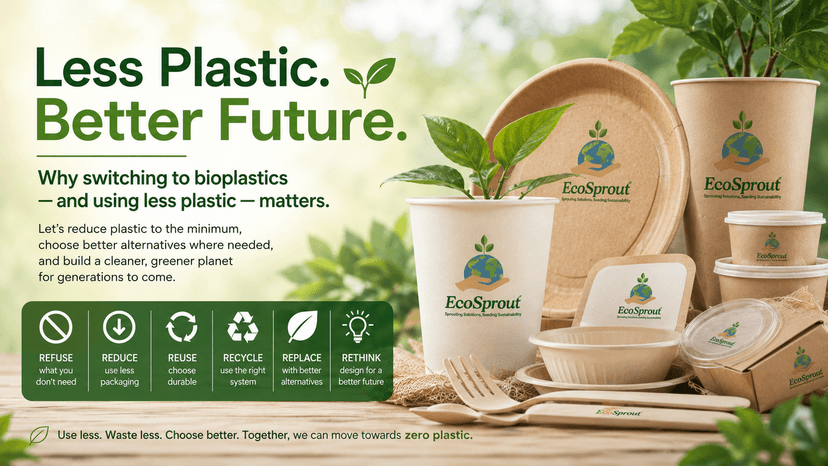
- Can we reduce the amount of material we use?
- Can a product be reused instead of discarded?
- Can it be recycled effectively?
- Is a bio-based material suitable for the application?
- If a compostable product is used, is there an appropriate composting system available?
- What happens to the product at the end of its life?
Sustainability is about looking at the whole picture, not just the material itself.
What Exactly Are Bioplastics?
The term “bioplastic” is often used broadly, but it can describe different types of materials.
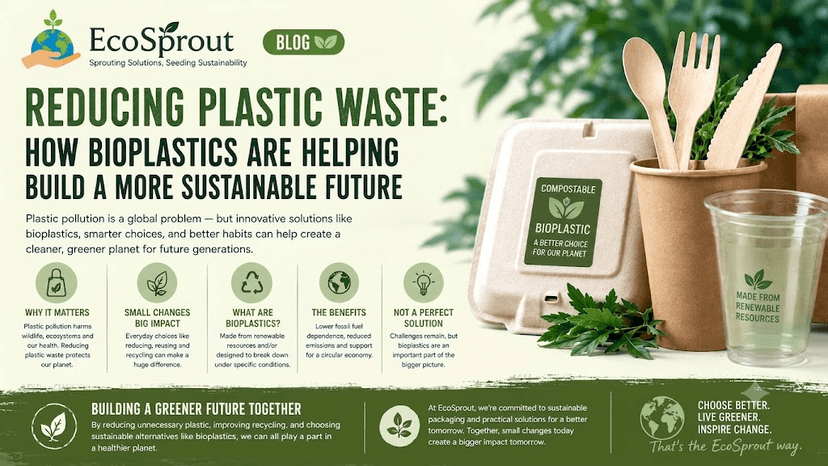
Bio-based plastics are made partly or entirely from biological resources rather than fossil fuels. These resources can include plant-based feedstocks and other renewable biological materials.
However, being bio-based does not automatically mean that a plastic is biodegradable or compostable.
Similarly, some plastics may be designed to biodegrade or compost under specific conditions, but they are not necessarily made from renewable biological resources.
Understanding these differences is essential for making informed and responsible choices. The European Commission and European Environment Agency both highlight the importance of distinguishing between bio-based, biodegradable, and compostable plastics, as their environmental benefits and end-of-life requirements can vary significantly.
At Ecosprout, we believe that sustainability should be based on clarity, transparency, and informed decision-making.
Why Bioplastics Matter
When carefully selected for the right application, bioplastics can offer potential advantages as part of a broader transition towards more sustainable materials.
One potential benefit of bio-based plastics is the opportunity to reduce reliance on fossil-based feedstocks. Certain biodegradable or compostable plastics may also provide useful solutions for specific applications where conventional recycling is difficult or where products are closely linked to organic waste streams.
But the key phrase is “the right application.”
Bioplastics should not be viewed as a magic solution to the global plastic problem. Their environmental performance depends on factors such as how they are produced, what resources are used, how long the product is used, and what happens after it is discarded.
In other words, a sustainable material is only truly sustainable when its entire life cycle is considered.
The Importance of the Circular Economy
The future of sustainable materials is closely connected to the idea of a circular economy.
A circular economy aims to keep products and materials in use for as long as possible while reducing waste and making better use of resources.
The ideal approach is often to follow a hierarchy:
Reduce → Reuse → Recycle → Recover
Where appropriate, compostable materials can also play a role, particularly when they are designed for specific applications and supported by suitable organic waste collection and processing systems.
This is why choosing a material should never be based solely on whether it has a “green” label. We need to consider what happens before, during, and after its use.
A well-designed sustainable product considers its complete journey—from sourcing and manufacturing to use, collection, recycling, composting, or disposal.
Bioplastics and the Future of Packaging
Packaging is one area where the search for more sustainable materials is particularly important.
Businesses and consumers are increasingly looking for packaging solutions that can help reduce environmental impact without compromising functionality, safety, or performance.
Bioplastics may provide opportunities in selected packaging applications, particularly where their material properties and end-of-life options align with the product’s intended use.
But packaging sustainability requires more than simply changing the material.
It also means:
- Using less material where possible
- Designing products for reuse or recycling
- Avoiding unnecessary packaging
- Clearly communicating disposal instructions
- Choosing certified materials where relevant
- Supporting effective waste-management systems
The best packaging solution is not necessarily the one that sounds the most environmentally friendly. It is the one that delivers the right balance of functionality, resource efficiency, durability, and responsible end-of-life management.
Biodegradable Does Not Mean “Disappears Anywhere”
One of the most important conversations around sustainable materials is the difference between biodegradable and compostable.
These terms are often used interchangeably, but they are not the same.
A biodegradable material may break down through biological processes under particular environmental conditions. A compostable material is designed to break down under defined composting conditions and, depending on the product and certification, may require an industrial composting facility.
This means that simply throwing a compostable product into general waste or littering it in the environment does not guarantee that it will break down as intended.
The European Environment Agency notes that the conditions in industrial composting facilities can differ significantly from those found in home composters or the natural environment. Correct collection, clear labelling, and appropriate waste infrastructure are therefore essential.
For businesses, this is an important lesson: sustainability claims must be accurate, specific, and supported by evidence. In the UK, the Advertising Standards Authority and CAP also emphasise that businesses making biodegradable or compostable claims should hold appropriate evidence to substantiate them.
The Role of Businesses in Creating Change
Businesses have a powerful role in shaping the future of materials.
Every decision—from product design and raw-material sourcing to packaging and waste management—can influence environmental outcomes.
By investing in sustainable innovation and making informed material choices, businesses can help drive the transition towards a more responsible economy.
But meaningful change requires collaboration.
Manufacturers need to develop better materials. Businesses need to choose them responsibly. Consumers need clear information. Waste-management systems need to evolve alongside new products.
No single organisation can solve the plastic challenge alone.
The transition to a more sustainable future will require innovation, accountability, education, and collective action.
A Greener Future Starts with Better Choices Today
The future of our planet will be shaped by the decisions we make today.
Choosing sustainable materials is one part of a much larger journey towards reducing waste and using resources more responsibly. Bioplastics can contribute to that journey when they are thoughtfully designed, appropriately used, transparently labelled, and supported by suitable end-of-life systems.
But the bigger opportunity lies in changing the way we think about materials altogether.
We need to move away from a culture of “make, use, and throw away” and towards a system where products are designed with their entire life cycle in mind.
That means choosing materials not just for how they perform today, but for what happens to them tomorrow.
Growing a Better Tomorrow with Ecosprout
At Ecosprout, we believe that sustainability is not about finding one perfect solution. It is about making better, more informed choices—one product, one business, and one decision at a time.
Bioplastics are part of an evolving landscape of sustainable materials. Their potential is significant, but their success depends on responsible innovation and a clear understanding of where and how they should be used.
The future we want will not be created by waiting for change.
It will be created by the choices we make today.
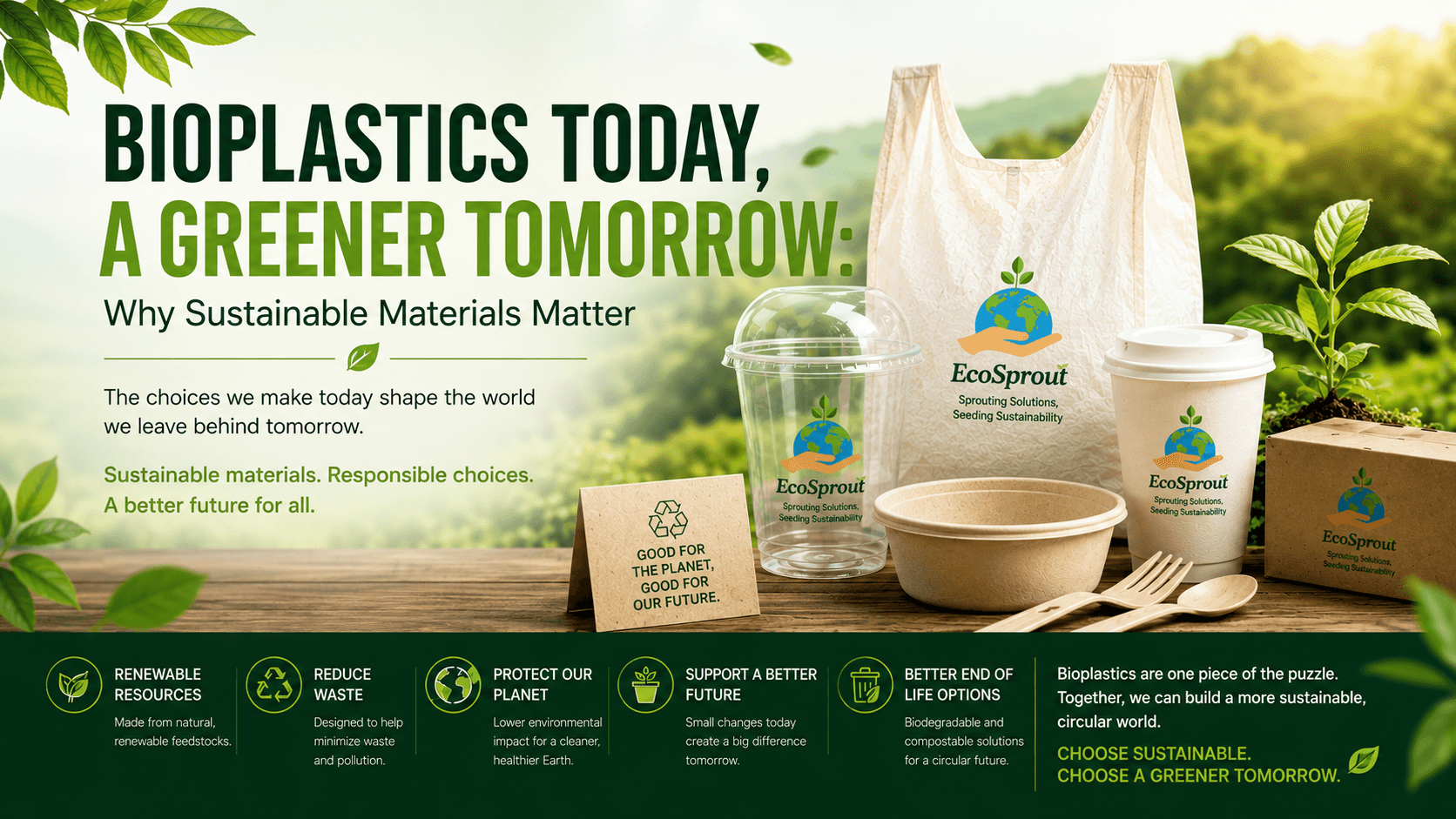
Bioplastics today. Better choices today. A greener tomorrow.
Let us work together to create a future where innovation and sustainability grow side by side.
Choose wisely. Think sustainably. Grow a greener future with Ecosprout.